joshua schachter's blog
amateur economist
Ever since seeing a presentation by Dolores Labs about Amazon's Mechanical Turk, I've been itching for an excuse to play with the system.
I recently saw a thread that highlights the distinction between expected value and utility. Would you take a more likely but lower payoff instead of a less likely but higher payoff? Similarly, the St. Petersburg Paradox takes the problem to its logical extreme. By constructing a game that has a series of increasingly rare payoffs of increasingly larger size, a game with infinite expected value is created.
So I constructed 21 versions of the questions, varying the size of the dollars as well as the rate of payoff for the second outcome.
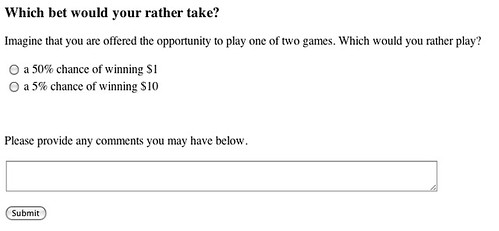
For one cent apiece, I sent the questions to be answered by one hundred people each, and collated the results. 2100 questions, three hours, and thirty dollars later, I have my results.
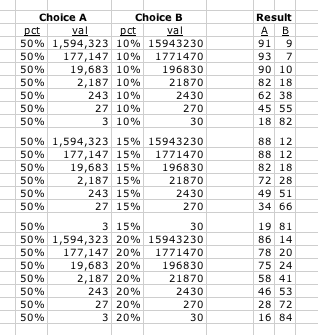
Clearly, people (or at least these Turks) begin to cross over at larger values, reaching equilibrium at around $1,000.
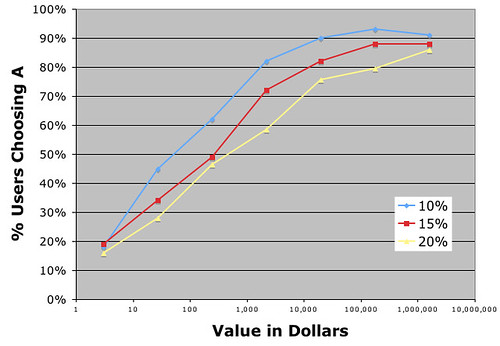
While this isn't the most groundbreaking work, it is nice to be able to generate an experiment and gather the results in the course of an evening and then have the results be so pleasing.
The Mechanical Turk is presented as a way to solve problems that are easily explained to people but difficult to implement for computers, frequently described as "artificial artificial intelligence." However, I think some of the most intriguing uses yet will be to explore the edges of our own uniquely human behavior and self-understanding.